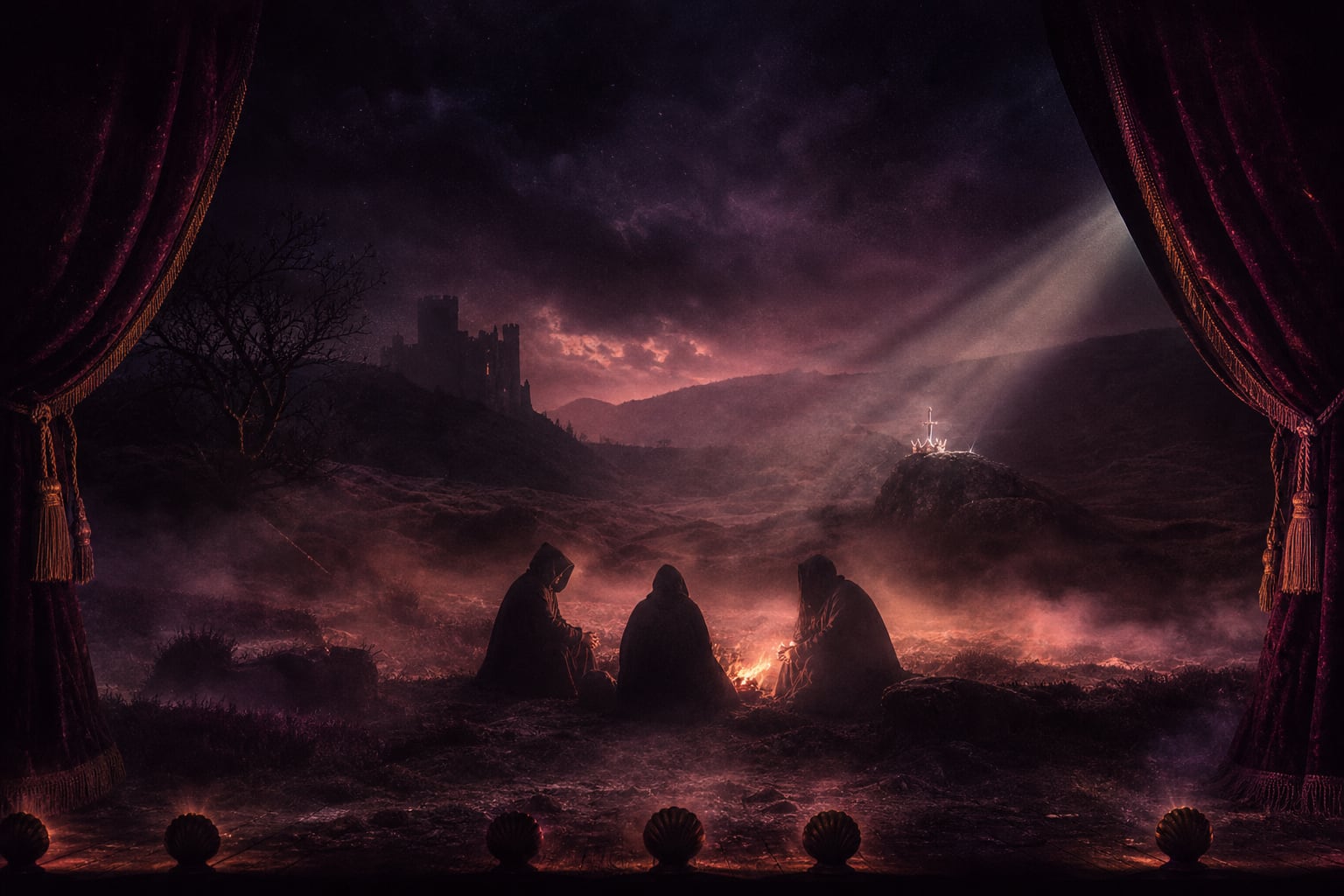
“‘Tis th’ attempt, and not the deed, that confounds us.” The line, spoken in the dark hours around a murder, captures the engine of Macbeth: not the crime itself but the act of reaching for it, and the ruin that reaching brings. For the Marco Island Shakespeare Festival, the Scottish play was a natural next step after the success of Julius Caesar — a second tragedy of power, staged by the same ensemble, directed by Kaitlynn McRae.
The production ran across two weekends in late May, on the 22nd, 23rd, and 24th, then again on the 30th and 31st.
A path of darkness
Macbeth is Shakespeare’s leanest tragedy, and its shape is brutally simple. Macbeth, a celebrated and battle-worn general loyal to King Duncan, returns from war and meets three witches in the wood. They promise him glory and a crown. The prophecy lodges in him like a splinter, and his ambitious wife drives it deeper. Together they murder Duncan in his sleep, and Macbeth takes the throne.
From there the play is a study in self-destruction. Each step Macbeth takes to secure his stolen power demands another killing, and each killing isolates him further. The supernatural forces that promised him a kingdom forswear and forsake him at every turn, until he is left ruling a country that wants only his ruin. Lady Macbeth, once the steadier nerve of the pair, unravels into sleepwalking guilt. By the close, Macbeth has nothing left to lose and faces his end with the grim courage of a man who has seen the bottom of his own ambition.
Why it works in a small room
On paper, Macbeth has armies, battles, and a roll of thanes and nobles. In practice, it is one of the most concentrated plays in the canon — short, fast, and built around a small core of roles. That makes it surprisingly well matched to an intimate stage. The horror of Macbeth is internal: it lives in the faces of two people talking themselves into murder. Up close, in a room of eighty-three seats, that pressure has nowhere to dissipate.
For a student-and-ensemble festival, the play also offers a rare combination of star roles and ensemble texture — the witches, the murderers, the doomed court — that lets a whole company contribute to a single, mounting dread.
Macbeth sat alongside the festival’s other classical work, including The Tempest, in a Shakespeare program that gave Marco Island something few small resort towns sustain. For the broader story of the company, see community theatre on Marco Island.
Frequently Asked Questions
When was Macbeth performed at The Marco Players?
The production ran across two weekends in late May, with performances on May 22, 23, and 24, followed by May 30 and 31. It was staged by the Marco Island Shakespeare Festival's ensemble.
Who directed the Marco Island production of Macbeth?
Macbeth was directed by Kaitlynn McRae for the Marco Island Shakespeare Festival, the company's Shakespeare strand. It followed the festival's earlier production of Julius Caesar.
What is Macbeth about?
Macbeth is Shakespeare's tragedy of ambition. A victorious Scottish general meets three witches who prophesy that he will become king. Spurred on by his wife, he murders King Duncan to seize the throne, then descends into paranoia and tyranny as he tries to hold the power he has stolen.
Why is Macbeth considered a good play for a small ensemble?
Although it has a large nominal cast, Macbeth is driven by a handful of central roles — Macbeth, Lady Macbeth, and the witches — and moves at a fast, concentrated pace. That focus makes it well suited to an intimate stage, where the psychological pressure on the leads reads powerfully up close.
What did the festival stage before Macbeth?
The festival presented Julius Caesar the previous season. Its success encouraged the company to continue building a recurring Shakespeare program on Marco Island, of which Macbeth was the next chapter.